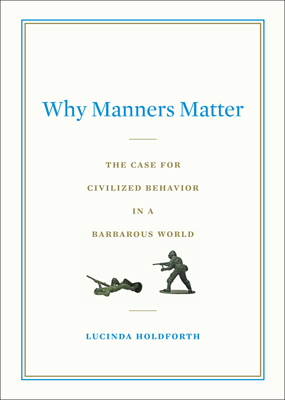
Why Manners Matter: The Case for Civilised Behaviour in a Barbarous World
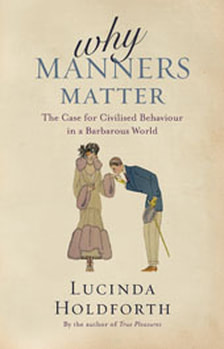
You know what it's like: whether it's the leaf blower blaring at 7am or the queue-jumper cutting in at the cinema, there's nothing like an act of rudeness to spoil the day. But why do so many of us get worked up about these examples of incivility? Isn't that just life?
Do manners really matter, anyway?
Yes! says Lucinda Holdforth, in this passionate and elegant essay, drawing on history's great writers and thinkers to argue, unashamedly, that manners are absolutely essential to civilisation. Holdforth wrests the case for good manners away from the knife-and-fork snobs, the exclusivist bores and the corporate fakers, to show how courtesy protects our rights and freedoms, strengthens our communities, and adorns our individual humanity. She shows us that privacy can co-exist with neighbourliness, that intellectual freedom can flourish within agreed social rules, and that civility saves us from over-legislation. Bold, brimming with anecdote and brilliantly conceived, Why Manners Matter is as witty as it is timely, and as forceful as it is charming. This important yet thoroughly entertaining little book will ensure you never take courtesy for granted again.
Do manners really matter, anyway?
Yes! says Lucinda Holdforth, in this passionate and elegant essay, drawing on history's great writers and thinkers to argue, unashamedly, that manners are absolutely essential to civilisation. Holdforth wrests the case for good manners away from the knife-and-fork snobs, the exclusivist bores and the corporate fakers, to show how courtesy protects our rights and freedoms, strengthens our communities, and adorns our individual humanity. She shows us that privacy can co-exist with neighbourliness, that intellectual freedom can flourish within agreed social rules, and that civility saves us from over-legislation. Bold, brimming with anecdote and brilliantly conceived, Why Manners Matter is as witty as it is timely, and as forceful as it is charming. This important yet thoroughly entertaining little book will ensure you never take courtesy for granted again.
|
'A clever, alert essayist presents her argument for an ancient virtue, confirming the old adage that manners maketh the man—and, she allows, enhanceth the woman too.In a world patently short on patience and apparently burdened with a surfeit of self-esteem, Holdforth (True Pleasures: A Memoir of Women in Paris, 2004) courteously goes directly to the point: We need civil behavior if civilization is to hold together. Consensual good manners, she asserts, are better than both laws and religion. As we have just discovered anew, greed is not good for us. Ever since the heyday of Athenian democracy, community service and cooperation have consistently made the world work better. Good manners, to be sure, are not evidenced by false intimacy invoked by relative strangers. Practitioners of more formal politesse, it may be noted, can maintain a shield against premature familiarity. Holdforth, a native of generally free-and-easy Australia, recalls with admiration the elaborate decorum of the constricted salons of Enlightenment Paris. She allows Lord Chesterfield to pronounce good manners beneficial to all; she enlists Castiglione, Proust and Talleyrand as witnesses. Good manners avert social confusion, she avers. They control narcissism, improve communication, provide social stability and just make life sweeter. Despite the frisson a fine theatrical display of bad manners can produce, proper behavior is a badge of humanity that enhances life, if just for a bit. So if you can't remove your artfully reversed baseball cap at the dinner table or turn off your iPhone in a crowd, at least try for some other little touch of considerate conduct. It will be good for us all. Who would be churlish enough to dispute that? Short, sweet and smart—not an etiquette manual, just a 21st-century reminder of the timeless practice and rewards of good manners. '
- Kirkus Reviews, 2009 |
'Why Manners Matter sets out a powerful case for a new set of subversive rather than conservative manners that are flexible enough to accommodate a variety of classes and cultures, and which may be essential to sharing an increasingly crowded space.’
- The Australian Literary Review 'I admit to an affinity for books on civility, perhaps because I myself once wrote one. Lucinda Holdforth’s delightful book is the best I have seen on this subject in many years. She sets herself the Herculean task of arguing for manners in a world that deems them unimportant. She is equally at ease with Rousseau and Rosa Parks, with the Bloomsbury Group and the Bible, with 19th- century etiquette books and 2-st century Hollywood. (She also makes reference to Castiglione’s 16th-century Book of the Courtier, among my favorites in my own college days.) Rejecting the cant that good manners are some sort of right- wing conspiracy, Holdforth persuasively links good manners not only to good character but to the stability and the progress of the society itself. Not to pay attention to a book this thoughtful might even be considered unmannerly.' - Stephen L. Carter, William Nelson Cromwell Professor of Law at Yale Law School, author of numerous books including the acclaimed The Emperor of Ocean Park Lucinda Holdforth (what a perfect name!) is the Marcus Aurelius of manners. She's a genius at how to live. Why Manners Matter is a wonderful, enticing, brash, deep, witty book. Read it. It will make you the nicest person of your generation." - E.Jean Carroll, Elle columnist "Impeccably researched and beautifully written." - Australian Financial Review Magazine Don't miss this small but compelling book. - P. M. Forni, author The Civility Solution |
'‘In Why Manners Matter, Lucinda Holdforth elegantly argues that manners not only maketh the man but are absolutely essential for civilised society. She states that manners preserve our own dignity and the dignity of others. What's more, she claims that "beautiful manners expand the radius of human cooperation and potential"….Brilliantly conceived, witty and delightfully idiosyncratic, Why Manners Matter is a thoroughly enjoyable and superbly insightful book. Everyone has been annoyed by examples of bad manners, from road rage to queue-jumping. Holdforth's slender volume, brimming with entertaining anecdotes, gives everyone the opportunity to put courtesy back into their daily lives. This is an unusual yet significant, politically-charged book. It's also passionate, sassy, amusing and charming’.
- The Independent Weekly, Adelaide ‘Yes, Yes I thought reading this humble offering - then, no, no. Then, yes, yes. …Manners, Lucinda Holdforth holds forth, in this brightly written study, are not petty. ….It doesn't take much to agree with the proposition that considerate codes of conduct are essential social glue’. - Non-fiction Pick of the Week, The Age ‘Holdforth certainly holds forth with conviction that we need a better understanding of, and a return to, good manners to achieve a civil society. She cites Louis XIV's Versailles Palace, Athenian democracy - and the 'veritable epidemic of good manners' that broke out in Sydney during the 2000 Olympics. Holdforth draws on a rich fund of anecdotes that makes Why Manners Matter an informative as well as an uplifting read’. - The Sun Herald “In this beautifully produced book, Holdforth draws as her inspiration writers and thinkers who regard manners as essential...a whimsical book, it should make us all the more passionate and aware about our dealings with our fellow humans”. - The Examiner (Launceston) |